-
-
-
Borivali East, Mumbai, India


Is Presumptive Taxation a "Tax Hack"? What Business Owners Get Wrong
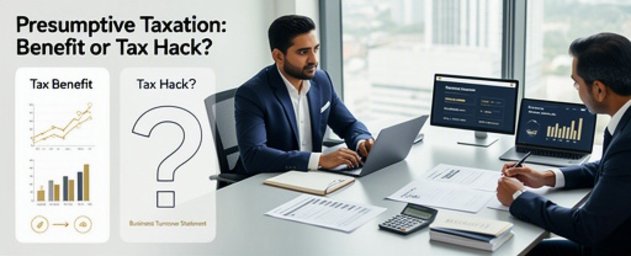
Is Presumptive Taxation a "Tax Hack"? What Business Owners Get Wrong
Introduction
In a recent client discussion, a business owner came in with a straightforward question. His business had a turnover of around ₹1 crore. He'd earned a certain profit during the year, but he'd come across something online: under presumptive taxation, he could declare income at 6%, and this, he believed, could significantly reduce his tax.
It's an understandable question. On the surface, it sounds like a simple way to lower a tax bill. But our Chartered Accountant's response to this is worth every business owner hearing: presumptive taxation is not a tax hack, and treating it like one can create more problems than it solves.
This article walks through why.
What Is Presumptive Taxation?
Presumptive taxation is a scheme designed as a benefit for eligible small business owners. Its purpose is to simplify compliance, mainly by reducing the need to maintain detailed books of accounts in cases where a taxpayer is eligible to use it.
Instead of tracking every expense and computing profit in the usual detailed manner, an eligible business owner can declare income at a prescribed rate on their turnover, and that becomes the basis for their tax computation.
It's worth being clear here: this piece is not about listing out the exact turnover limits, eligibility conditions, or specific percentage rates under provisions like Section 44AD, since those details depend entirely on your specific facts and current law. What matters for this discussion is the underlying purpose of the scheme, not its mechanics.
Is Presumptive Taxation a Tax Hack?
No, and this is the core message from our Chartered Accountant's response to the client.
Presumptive taxation exists to make compliance easier for genuinely eligible small businesses. It was never designed to let a business owner pick a lower number simply because it results in less tax.
The scheme assumes that the declared income reasonably reflects the business's actual financial position. When someone starts approaching it as a formula for reducing tax rather than a genuine reflection of their business, they've misunderstood what the scheme is for.
Our expert's point is simple: use the scheme correctly, and report income accurately. Don't treat it as a way to artificially reduce your tax liability.
Why Accurate Income Reporting Matters
Here's something every business owner should sit with: the Income Tax Department has access to significant amounts of taxpayer information, and it uses technology, data analytics, and other information sources to identify discrepancies.
This means your tax return doesn't exist in isolation. Your bank transactions, your GST filings, your vendor and customer payments, and various other financial data points all form a picture. If a taxpayer's financial activity does not appear consistent with the income being reported, simply relying on a presumptive taxation calculation may not tell the complete story.
In other words, declaring a lower income under a presumptive rate doesn't erase the rest of your financial footprint. If your actual business activity, your spending, your bank deposits, or your lifestyle don't line up with what you've declared, that inconsistency doesn't just quietly disappear.
What Business Owners Should Understand Before Using Presumptive Taxation
Before deciding to use a presumptive scheme, there are a few things worth genuinely thinking through:
- Are you actually eligible? Eligibility depends on specific conditions tied to your business type and turnover, and these need to be checked case by case rather than assumed.
- Does the declared income reflect reality? The scheme is meant to simplify reporting for a business whose actual profit is broadly in that range, not to let you pick whichever number results in the lowest tax.
- Is your overall financial picture consistent? Your bank activity, GST returns, and other filings should reasonably align with what you're declaring in your income tax return.
- Are you doing this every year for convenience, or picking it selectively when it benefits you? The scheme's intent is administrative simplicity, not an opportunistic tax-planning tool.
If you're unsure where you stand on any of these, that's a conversation to have with a professional rather than a decision to make off an online search result.
Why Your Tax History Matters Beyond Tax Filing
One of the more practical points our Chartered Accountant makes is about the bigger picture. As the expert puts it, the broader advice is to always pay taxes that help you grow your file.
Accurate tax compliance isn't just about staying on the right side of the law in the moment. It builds a financial history. And that history can matter later, in situations like:
- Visa applications, where consistent, credible income tax records are often reviewed
- Applying for credit facilities, such as loans, where lenders look at your reported income and tax history as part of assessing your credibility
- Other situations where your financial records and tax history may matter, whether that's a business opportunity, a partnership, or a future transaction
If you've spent years reporting artificially low income to save on tax, that same low income is now your "official" financial history. It can work against you exactly when you need to show real financial strength.
Common Mistakes to Avoid
- Choosing a presumptive rate purely because it results in less tax, without genuinely evaluating whether the underlying declared income is accurate
- Assuming any business with a turnover around a certain figure automatically qualifies, without checking the actual eligibility conditions
- Ignoring inconsistencies between your bank activity, GST filings, and reported income, assuming these won't be noticed
- Treating tax filing as a yearly formality rather than as something that builds your long-term financial credibility
- Making tax decisions based on something read online, without a proper professional review of your specific situation
Practical Takeaways
- Presumptive taxation is a compliance-simplification benefit for eligible small businesses, not a tax-reduction shortcut.
- The Income Tax Department uses data and technology to cross-check reported income against other available financial information.
- Declared income should genuinely reflect your business activity, not just the number that minimizes tax.
- Whether you're eligible for a presumptive scheme, and at what rate, depends on your specific facts and should be checked properly.
- Accurate, consistent tax history has value beyond tax season, including for visas, credit applications, and other financial situations.
- When in doubt, get professional advice before deciding how to report your income.
Frequently Asked Questions
1. Is presumptive taxation only meant for reducing tax liability?
No. As our Chartered Accountant explains, it's designed as a benefit for eligible small business owners to simplify compliance by reducing the need for detailed bookkeeping, not as a way to artificially lower tax.
2. If my turnover is around ₹1 crore, does that automatically mean I can use the 6% presumptive rate?
Not necessarily. Eligibility for any presumptive scheme depends on specific conditions that need to be checked against your actual facts. A turnover figure alone doesn't confirm eligibility or the applicable rate.
3. Can the Income Tax Department tell if my declared income doesn't match my actual business activity?
Our expert notes that the department has access to significant taxpayer information and uses data analytics to identify discrepancies. If your reported income doesn't align with your broader financial activity, that inconsistency can be flagged.
4. Why shouldn't I just declare the lowest income the scheme allows?
Because the scheme is meant to reflect a genuine, reasonable estimate of your income, not the lowest permissible figure. Treating it as a tax hack goes against the purpose it was designed for.
5. How does accurate tax reporting help me outside of tax filing?
As our Chartered Accountant points out, consistent and accurate tax compliance can matter when applying for visas, credit facilities, and in other situations where your financial records and tax history are reviewed.
6. Should I decide on my own whether presumptive taxation applies to me?
It's best not to. Since eligibility and applicable rates depend on your specific circumstances, this is a decision worth making with proper professional guidance rather than based on general information found online.
7. What's the real risk of misusing presumptive taxation?
Beyond the compliance risk of inconsistent reporting, there's a longer-term cost: your official financial history ends up understating your actual position, which can limit you later when accurate records would have helped.
Conclusion
Presumptive taxation is a genuinely useful scheme when used the way it's intended, as a compliance simplification for eligible small businesses. It was never meant to be a formula for cutting your tax bill by picking a convenient number.
As our Chartered Accountant's client discussion shows, the smarter approach is to report your income accurately, understand whether you're genuinely eligible for the scheme, and think about your tax history as something you're building for the long run, not just settling for this year.
Not Sure If Presumptive Taxation Applies to Your Business?
Every business is different, and eligibility for schemes like presumptive taxation depends on your specific facts. Our team at VPRP & Co LLP can help you assess your situation properly and make sure your income tax filing reflects your business accurately. Get in touch with us to discuss your case.
Need help applying this?
Speak with a Chartered Accountant in Mumbai
Get practical guidance from VPRP & Co LLP on tax, GST, audit, compliance, valuation or business advisory questions related to this topic.